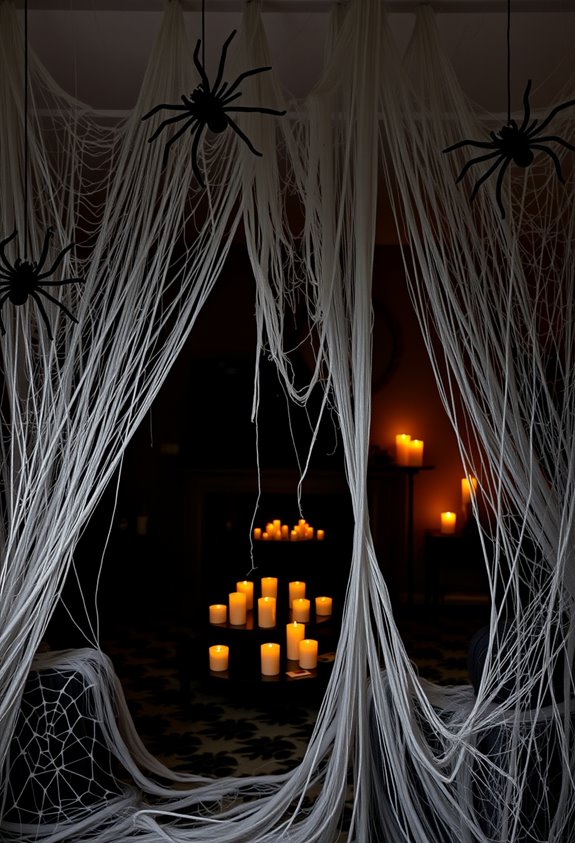
Spider webs are Halloween’s most underrated weapon. You can stretch them across bare walls for maximum contrast, hang them from doorframes and light fixtures, or go full chaos mode outdoors with rope webs between trees and fences. Light them up with LEDs and they cast genuinely creepy shadows after dark. You don’t need a big budget either — yarn and cotton balls work fine. Stick around and you’ll transform any space from forgettable to seriously unsettling.
Design Highlights
- Target bare wall gaps and clean surfaces before applying webbing to maximize visual contrast and creepiness.
- Anchor webs to light fixtures, door frames, and ceiling corners to keep material stretched and authentically eerie.
- Create irregular, chaotic outdoor webs using heavy-duty rope stretched between trees, fences, and rebar anchors.
- Thread LED string lights center-outward through web loops to add glowing depth and dramatic shadows.
- Layer white and gray cotton strands, suspend spiders on fishing line, and use uplights for floating, realistic effects.
Stretch Spider Webs Across Walls and Mirrors
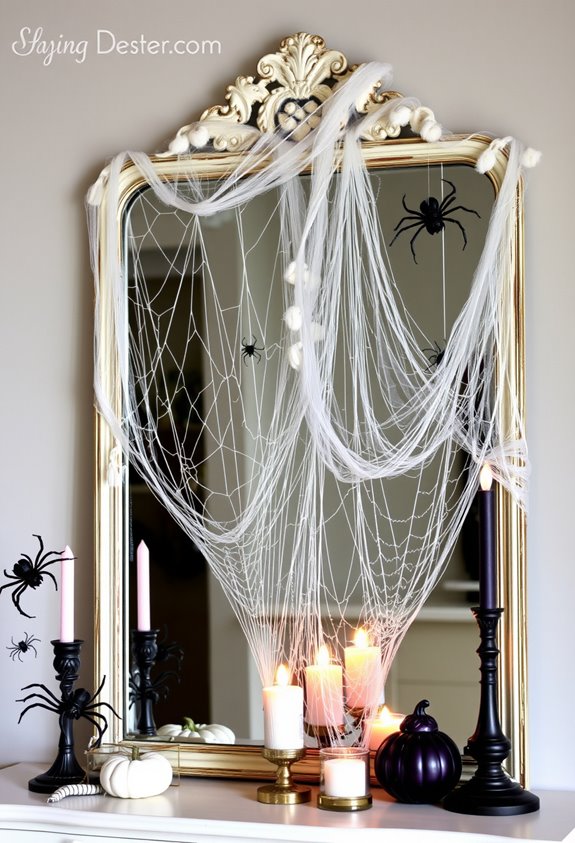
Stretching spider webs across walls and mirrors is one of the easiest ways to pull off a convincing Halloween setup. Start by targeting bare wall gaps — not already crowded surfaces. Clean space equals stronger visual contrast. Stretch the material thin, almost to its breaking point, because clumped webbing looks like craft store leftovers, not a haunted house.
Work with small pieces. Seriously, a little goes a long way. Pull apart any thick strands and shape them into angular connections for that authentic, abandoned-corner look. Tape ends firmly to walls, corners, and edges so nothing sags. For mirrors, hook a tiny piece across opposite corners asymmetrically — the reflection does half the work for you. Space everything deliberately. Organized reads as spooky. Random reads as messy.
Where no natural hook points exist on walls or surfaces, press velcro dots to anchor the web securely without damaging anything underneath.
Hang Spider Webs From Ceilings and Doorways
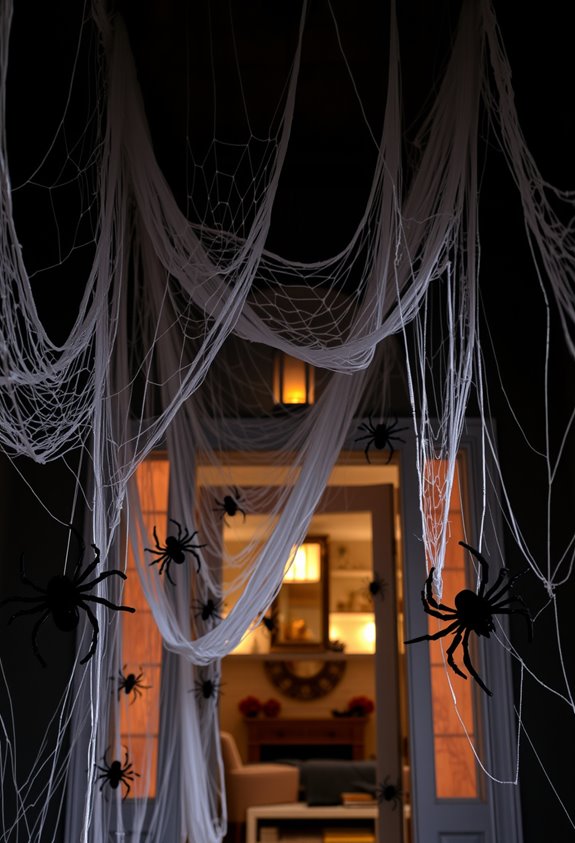
Hanging spider webs from ceilings and doorways hits differently than wall placement — these spots mimic where cobwebs actually build up in abandoned spaces, so the effect reads as genuinely unsettling rather than obviously decorative.
Ceiling and doorway webs don’t just decorate — they convince. That’s where real cobwebs live.
Anchor your webs here for maximum creep factor:
- Light fixtures and curtain rods give you natural edges to hook into
- Door frames and top supports hold doorway webs taut without sagging
- Lower edges should hang about a foot off the ground — tripping your guests isn’t the scare you want
- Narrow openings need webs positioned slightly away from walls so people pass through without destroying everything
- Ceiling corners keep the material stretched and authentically eerie
For attachment, clear push pins or thumb tacks are the easiest way to secure webs to ceilings and door frames without causing damage.
Done right, your guests will feel it before they see it.
Take Your Spider Web Decor Outdoors
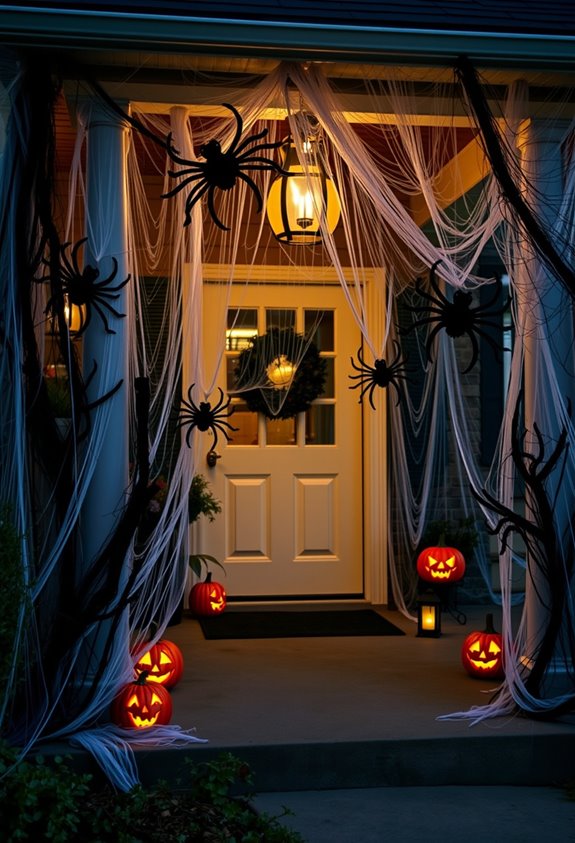
Outside is where the real display potential lives.
Stretch heavy-duty rope or galvanized wire between trees, fences, and lawn anchors to build webs that actually stop people in their tracks.
Drive rebar into the ground at at an angle, tie everything down with a trucker’s hitch, and use a three-point frame — house anchor plus two ground anchors — to keep the shape solid.
Don’t make it too neat. Irregular, chaotic patterns look far more convincing than anything symmetrical.
Thread webbing through planters, bike handles, and porch railings to spread the scene.
Add plastic spiders in multiple sizes, hang cotton batting egg sacs from branches, and light the whole thing from below with battery-operated LEDs.
Seal your rope ends after cutting. For a porch-specific setup, ceiling hooks originally used for hanging baskets make surprisingly solid anchor points for the whole structure.
Your neighbors will talk.
Light Up Your Spider Webs for After-Dark Impact
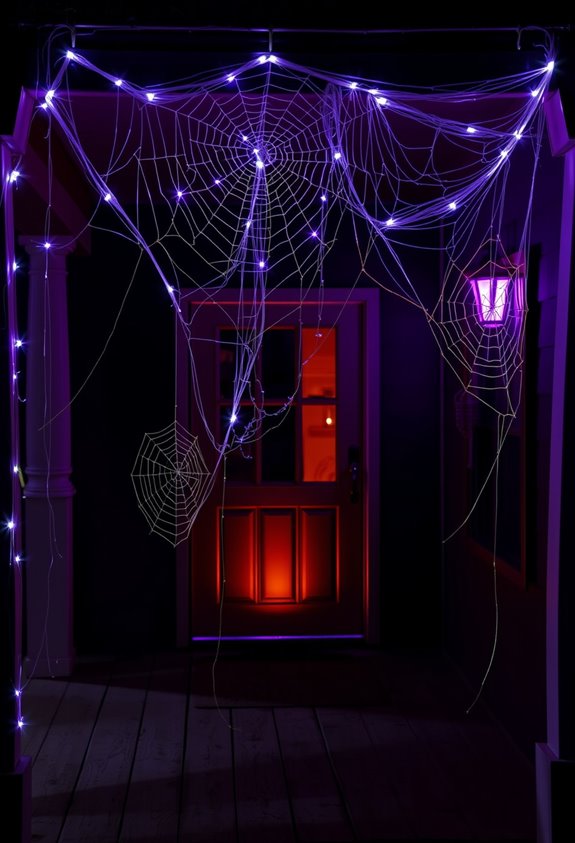
Thread LED string lights through your web strands and the whole thing transforms after dark. No big reveal needed—it just works.
Here’s what makes the difference:
- Route lights through existing web loops so the glow feels built-in, not tacked on
- Follow a center-outward pattern so the light reads as part of the web’s actual structure
- Use black gaff tape to hide wires, clips, and battery packs—nobody wants to see the backstage mess
- Pull the web slightly away from the wall so lit strands cast real depth and shadow
- Keep spacing imperfect—the web doesn’t need to be uniform to look cohesive at night
A stable, tensioned frame keeps those illuminated lines exactly where you put them. Sagging ruins everything.
Make Spider Web Decor on a Tight Budget
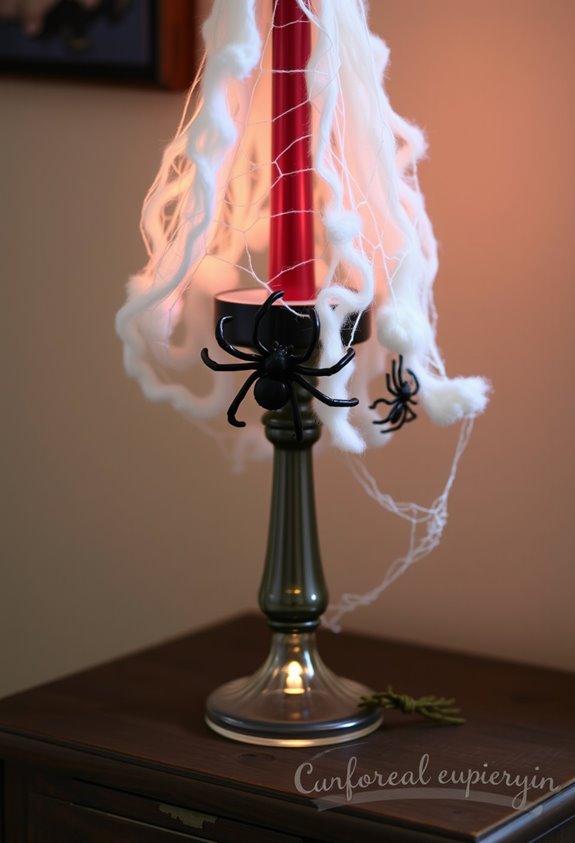
Pulling off great spider web decor doesn’t require blowing your budget. Seriously, you don’t need much. Grab a skein or two of black yarn, some tape, and scissors. Crisscross three or four yarn lengths into spokes, keep the tension loose so pieces don’t pop free, and skip perfect symmetry. Imperfect looks more real, anyway.
Got old cotton balls or pillow stuffing sitting around? Pull them thin and stretch them across surfaces. Instant wispy webs. Mix white and gray for depth.
Dollar-store spider rings scattered on shelves and tables add impact without wrecking your wallet. Glue a few onto candles or picture frames. Even better, cut black paper spiders from scrap card stock. Zero cost. Done.
Budget-friendly wins here. Every time. For a more structured outdoor display, you can recreate a stunning illuminated spider web using tomato cages and wire for around $39, compared to $159 for a similar store-bought version.
Mix Spider Webs Into Your Full Halloween Scene
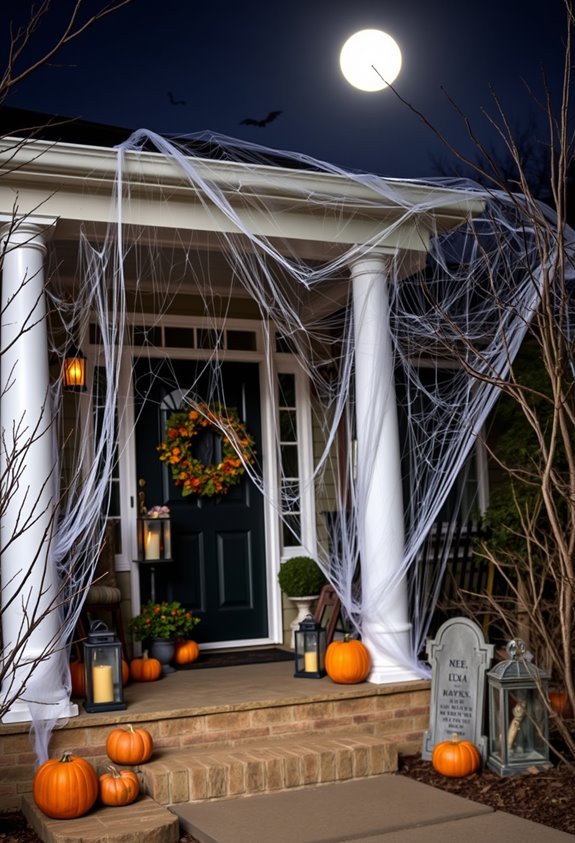
Across a well-decorated room, spider webs work hardest when they’re everywhere, not just tucked into one corner like an afterthought. You want your space to feel like nobody’s lived there in decades. That takes commitment.
Stretch webs across the whole scene by hitting these key zones:
- Furniture, mirrors, shelves, and light fixtures for a unified haunted look
- Corners, curtain rods, and picture frames as natural anchor points
- Doorways, porches, windows, and stairs to connect indoor and outdoor areas
- Cabinets and bookshelves for that abandoned-mansion energy
- Ceiling lines to pull every element together from above
Start at the top and work down. Layer webs over each other for real depth. One flat sheet of webbing isn’t fooling anyone. Go chaotic, go full, go haunted. For an easy starting point, grab stretch faux spider webs at Target, Michaels, or Party City and drape them over your highest surfaces first before working your way down.
Style Your Spider Webs for Maximum Visual Impact
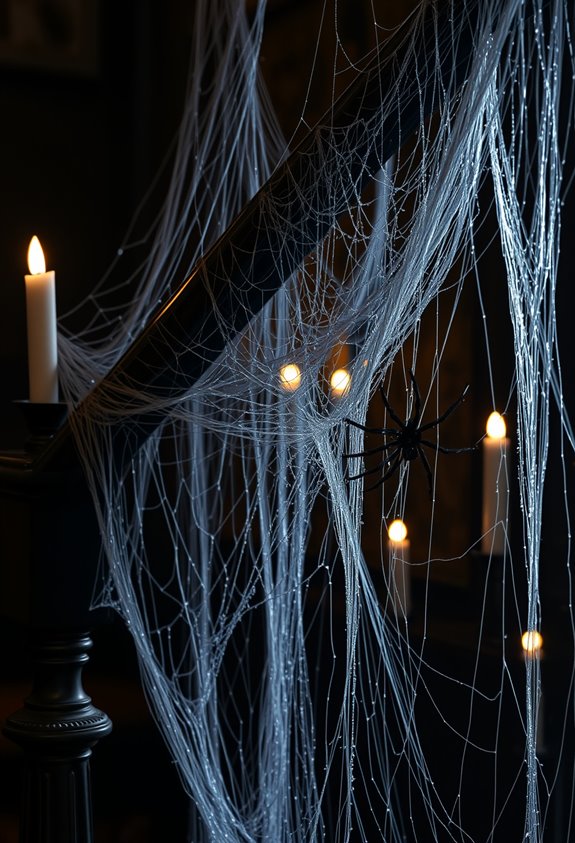
Stretching webs everywhere is a solid start, but placement alone won’t save a flat, lifeless display. Style matters. A lot.
Skip the perfectly straight lines. Natural cobwebs are chaotic, uneven, and a little sad-looking — lean into that. Tease apart clumped strands, stretch sections unevenly, and mix white and gray webs so nothing looks one-dimensional. Layer them across corners, mirrors, and light fixtures rather than spreading them thin across every surface.
Lighting changes everything. Uplights beneath draped webbing create a genuinely unsettling glow. Spotlights highlight texture after dark. Trust the shadows. LEDs and projectors cast dynamic shadows through webs, deepening the eeriness in ways basic bulbs simply can’t match.
Then hang webs loosely so airflow makes them shift. Add spiders in different sizes for scale. Suspend a few from fishing line for that floating effect everyone stops to stare at. Done right, your display feels alive.
Frequently Asked Questions
Are Faux Spider Webs Safe to Use Around Pets and Small Children?
Faux spider webs aren’t fully safe around pets and small children. You’ll want to keep them out of reach, away from heat sources, and check them often to prevent entanglement, choking, or fire hazards.
How Do You Store Spider Web Decorations After Halloween Without Tangling?
Accordion-fold your web from top to bottom, wrap it into a compact bundle, and secure it with twist ties. Store it in a labeled plastic bin somewhere cool and dry so it’s ready for next Halloween!
Can Spider Web Decor Trigger Real Spiders to Nest Nearby?
Your fake webs won’t trigger real spiders to nest nearby. Spiders respond to food, shelter, and moisture—not decorative materials. They might use your decor as a resting spot, but it’s not actively recruiting them.
How Early Before Halloween Should You Put up Spider Web Decor?
You’ll want to put up your spider web decor in early October—it’s the sweet spot everyone uses! It keeps the spooky vibes fresh all month without losing that exciting, festive feeling before Halloween arrives.
Are Halloween Spider Webs Fire-Resistant or Flammable Near Candles?
Halloween spider webs aren’t fire-resistant — they’re highly flammable. You’ll want to keep your spooky décor away from candles, away from open flames, and away from heat sources to protect your festive space.
Conclusion
Spider webs might be the simplest Halloween decoration you’ll ever use, but don’t underestimate them. They’re cheap, versatile, and genuinely creepy. Americans spend over $3 billion on Halloween decorations annually, yet a $2 bag of stretch cobwebs can outperform decorations costing twenty times more. You’ve now got seven solid ways to make them work. Indoors, outdoors, lit up, budget-friendly — there’s no excuse for a boring setup. Get weird with it.